
 FR
FR fortil
Post-combustion CO2 capture systems (Carbon Capture and Storage – CCS, or Carbon Capture, Utilization, and Storage – CCUS) installed at the stack outlet rely primarily on the use of amine-based solvents. During the capture process, the system is not entirely closed; consequently, emissions of amines and ammonia—resulting from repeated absorption and high-temperature regeneration cycles that degrade the amines by breaking their chemical bonds—can occur in the treated flue gas released into the atmosphere.
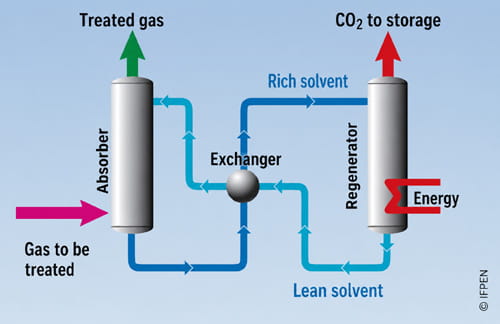
Figure 1 - Schematic diagram of the CO2 capture process via absorption (source: IFPEN)
A key characteristic of amines is that they undergo chemical degradation in the atmosphere via various pathways (such as oxidation by OH radicals or photolysis), and this degradation occurs rapidly (ranging from less than an hour to a few hours). Nitrosamines and nitramines, which result from the atmospheric transformation of amines, are far more toxic than the amines themselves. Some are highly carcinogenic, even at very low concentrations. Furthermore, these transformations promote the formation of secondary aerosols.
For any CO2 capture project—whether at existing or new sites—assessing the atmospheric impact of amine emissions and their health effects is becoming a priority.
Modeling the atmospheric dispersion of amines
Given the high chemical reactivity of amines in the atmosphere, the conservative approach of treating them as passive tracers—as is done in most modeling for VOCs, SO2, etc... would lead to an overestimation of amine concentrations and fails to account for the concentrations of secondary compounds. It is essential to consider the specific characteristics of these compounds and the chemical transformations they undergo.
Several approaches, ranging in complexity, are possible: using conversion factors from the literature, applying conservative assumptions to bound the formation yields of secondary compounds, or explicitly modeling the chemical reactions involved.
Some Gaussian or Lagrangian models can incorporate additional—often simplified—chemical modules specifically designed to address amine-related issues.
Eulerian models, particularly chemical-transport models, are equipped to solve complex chemical systems and sometimes incorporate the specific characteristics of amines. However, these models are computationally intensive and are not suitable for analysis across all spatial scales.
Among the most widely used atmospheric dispersion tools on the market, the ADMS model has, for several years, included a specific module for amine chemistry.
The ADMS Amines module
The development of the Amines module for ADMS is directly aligned with the SCOPE project (Sustainable OPEration of post-combustion Capture plants, https://www.scope-act.org), funded by the international ACT (Accelerating CCS Technologies) program, which focuses on research into CO2 capture, storage, and utilization (CCUS). Bringing together industry representatives, regulators, and researchers, this project aims to deepen the understanding of amine-based solvent CO2 capture processes by developing modeling tools, experimental data, and appropriate environmental assessment methods. Consequently, at the initiative of the SCOPE project, CERC developed an amine-specific module within ADMS, enabling the modeling of their atmospheric dispersion as well as the formation of nitrosamines and nitramines associated with CO2 capture facilities.
This module is available as an optional add-on for ADMS and incurs an additional cost.
In broad terms, the degradation of an amine in ADMS is modeled using a generic reaction scheme, which is shown in the following figure.
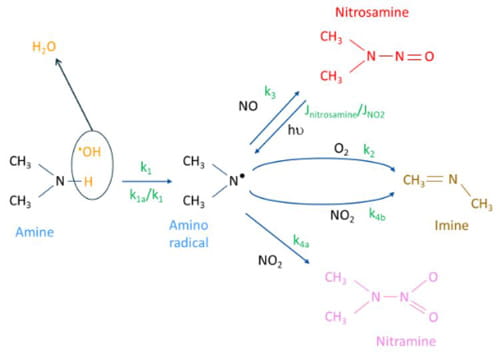
Figure 2 - Generic amine degradation scheme (source: CERC)
For each emitted amine, it is therefore necessary to configure the various reaction constants and parameters: the amine/OH reaction constant, the rate constant for the amino radical/O2 reaction, the rate constant for nitrosamine formation, the rate constant for nitramine formation, the rate constant for the amino radical/NO2 reaction, the branching ratio for the amine/OH reaction, the J-nitrosamine/J-NO2 ratio, and the constant for OH concentration calculations.
For OH radical concentration calculations, a supplementary tool provided with the ADMS Amines license uses meteorological data and background concentrations (ozone, NOx, etc.) to provide this information during the ADMS calculation.
Furthermore, it is possible to define Henry's law constants for the absorption of amine compounds into the water within particles or droplets.
NUMTECH’s support
In chemical absorption processes, primary and secondary amines are generally preferred due to their high reactivity with CO2 and rapid absorption rates. Conversely, tertiary amines exhibit slower absorption kinetics but offer greater efficiency.
Among the most widely used solvents, monoethanolamine (MEA) serves as the industry benchmark for post-combustion capture processes. However, the stability of the resulting carbamates necessitates high regeneration energy to release the CO2 during the desorption stage, representing one of the process's major energy costs. Furthermore, amine solutions—particularly those containing MEA—are susceptible to thermal and oxidative degradation, which can lead to the formation of by-products, corrosion issues, and solvent loss through volatilization. These limitations drive up operating costs and increase environmental constraints.
Consequently, strategies combining primary and tertiary amines, or secondary and tertiary amines, are currently being developed to optimize the trade-off between absorption rate, capture capacity, and energy consumption. A challenge arises from the fact that physicochemical data for these various compounds are rapidly evolving, with some remaining at the experimental stage.
While standard compounds have pre-set parameters available for the ADMS Amine module, configuring ADMS for these new compounds requires specialized expertise.
This is where NUMTECH offers its expertise to model amines or conduct dispersion studies for your CCS project.
