
 FR
FR fortil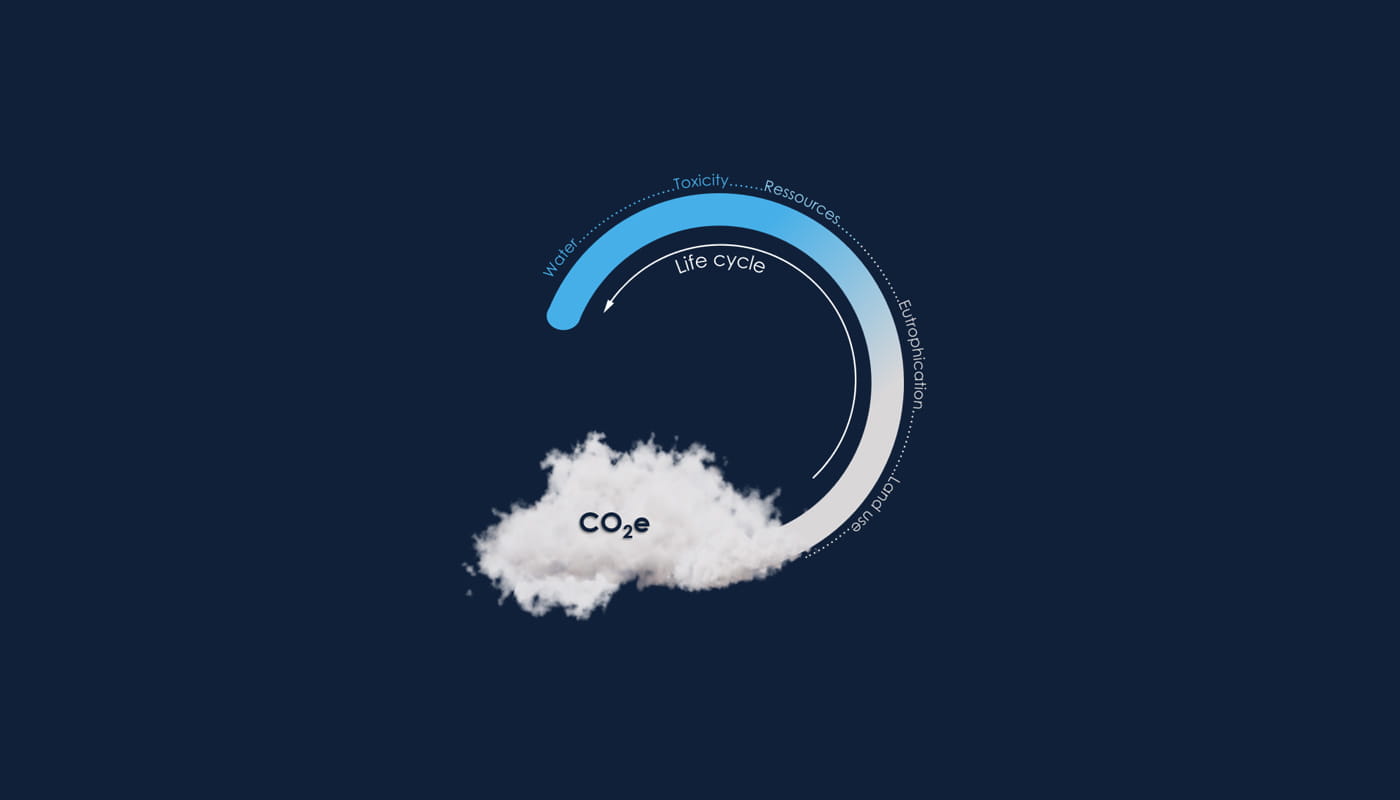
How can you transform a climate strategy into concrete decisions?
Why not complement your Carbon Footprint with a more operational tool such as LCA?
To accelerate their transition, companies are no longer limiting themselves to measuring their Carbon Footprint. They are now seeking to manage their environmental performance globally, by integrating all environmental impacts of their activities and products, in order to obtain a more complete vision of their actual impact.
Carbon Footprint: a key tool for structuring your decarbonization strategy
Carbon Footprint is today an essential tool for any organization wishing to structure its climate strategy.
It allows you to:
- measure greenhouse gas (GHG) emissions,
- identify main emission sources (energy, transport, procurement, etc.).,
- build a low-carbon transition plan.
Conducted at the organizational level, it provides a macro-level view essential for guiding strategy. It also serves as a key tool for management, ESG reporting, and regulatory compliance.
Its main limitation lies in its single-criterion approach—focused solely on carbon—which offers only a partial view of a company's actual impact. Furthermore, significant uncertainty can affect the data used: in the absence of detailed data (e.g., from suppliers), companies often rely on sectoral averages or generic emission factors. Additionally, some methodologies or tools are based on opaque assumptions or inaccessible databases. This yields orders of magnitude that are useful for raising awareness but insufficient for granular operational management.
LCA: an operational lever to reduce environmental impact
LCA is a standardized method that assesses the environmental impacts of a product or service throughout its entire life cycle.
It provides a comprehensive, multi-criteria view of a product’s environmental footprint, from raw material extraction to the end-of-life stage.
By evaluating several criteria—such as:
- climate change (carbon footprint),
- water consumption,
- resource depletion,
- air, water, and soil pollution,
- impact on ecosystems,
Why integrate LCA into your environmental strategy?
For an industrial company, conducting a product LCA makes it possible to shift from a measurement-focused approach to an action-oriented one by:
- comparing various production or eco-design scenarios,
- optimizing industrial processes,
- reducing costs (materials, energy, transport),
- driving R&D and innovation,
- improving environmental communication,
- meeting regulatory requirements and standards (such as PEF).
It thus serves as a key lever for sustainably improving corporate environmental performance.
Why combine LCA and Carbon Footprint?
It is in their combination that these two tools reveal their full potential.
From global to operational
The Bilan Carbone® provides a comprehensive overview and helps identify priorities.Meanwhile, LCA refines the analysis at the product level and informs technical decisions.
More reliable analyses
Data derived from LCA helps refine specific emission factors and improve the accuracy of the Bilan Carbone®.A complete environmental vision
This complementarity helps avoid impact shifting—reducing GHG emissions without compromising other indicators (water, resources, biodiversity).Towards global environmental performance
Today, companies must address a range of environmental issues: climate change, resources, pollution, and biodiversity.
The Bilan Carbone® addresses the climate challenge, while LCA broadens the analysis to encompass all impacts.
Conclusion: from strategy to concrete action
The Bilan Carbone® and LCA play distinct yet complementary roles:
- The Bilan Carbone® structures the climate strategy.
- LCA guides operational decisions.
By combining them, companies move from a comprehensive assessment to concrete actions that are coherent and aligned with current environmental challenges.
