
 FR
FR fortil
Emerging pollutants are newly identified chemical substances that may impact health or the environment but are not yet—or are only partially—addressed by regulations. They can originate from various sources, such as industry, agriculture, vehicles, and consumer products. Their emergence is often linked to evolving industrial practices, consumption patterns, and technologies. Some of these emissions occur in the atmosphere.
Despite being classified as "emerging", current modeling tools are nonetheless capable of simulating their dispersion in environmental impact studies. For many of these pollutants, their physicochemical behavior in the atmosphere requires no special adjustments; they can be modeled using standard methods, similar to those applied to compounds such as polycyclic aromatic hydrocarbons (PAHs), particulate-phase metals, or odors.
Which pollutants are we talking about?
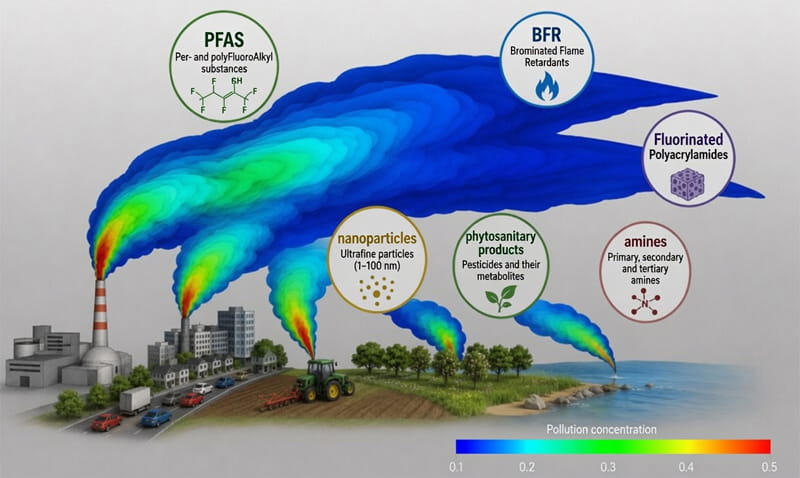
A large number of substances can be classified as emerging pollutants, including:
- Poly- and perfluorinated chemicals (PFCs), including per- and polyfluoroalkyl substances (PFAS): These are chemicals used in many consumer products, such as non-stick coatings, food packaging, waterproof textiles, and fire-retardant foams. They can be released into the atmosphere in various ways—for example, during production at industrial sites, during use, or during disposal in incinerators. They are persistent in the environment and are suspected of having adverse effects on reproduction and development, as well as implications for wildlife. Used extensively since the 1950s, this family comprises several thousand compounds.
- Brominated flame retardants (BFRs): These are chemicals added to many materials to reduce their flammability. They are widely used in furniture, textiles, electronic products, and construction materials. Atmospheric emissions occur during their use or disposal. BFRs are bioaccumulative and can have health effects on humans, such as hormonal disruption and neurological problems.
- Ultrafine particles (UFPs) and nanoparticles: These airborne particles, with diameters smaller than 0.1 µm, are often produced by industrial processes or chemical reactions. They can affect respiratory and cardiovascular health due to their ability to penetrate deep into the respiratory tract and cause cellular damage.
- Plant protection products: These encompass various families of chemical compounds that can be transported as particles or gases, depending on how they are released into the atmosphere (either directly during spraying or via drift). They can impact human health and ecosystems.
- Amines: These are organic compounds derived from ammonia. They are used in many fields—such as medicine (painkillers including paracetamol, antidepressants, and antihistamines), thanks to the nitrogen in amines that interacts readily with the human body; household products (detergents, disinfectants, shampoos, and cosmetics); agriculture (pesticides and herbicides); and industry (for manufacturing materials like foam and plastic, and as industrial mold cleaners). Most recently, they have been used in post-combustion gas treatment for CO2 capture. Their atmospheric degradation leads to the formation of toxic secondary compounds, some of which are suspected of being carcinogenic.
Can their atmospheric dispersion be modeled using current tools?
For most of these compounds, provided their emission rates are known, the answer is yes.
To date, when using local-scale modeling tools such as ADMS, modeling the dispersion of these emerging pollutants presents no greater difficulty than modeling currently regulated pollutants like PAHs or metals.
Challenges may arise regarding the emission process and how it is configured within a dispersion model typically used for impact assessments; for instance, pesticide spraying might require representing the emission source as a volumetric emission, which entails the difficulty of estimating the concentration within that initial volume.
Regarding atmospheric transport, modeling difficulties arise if rapid physicochemical changes occur that need to be accounted for in the model. This is the case with amines, where rapid transformation produces toxic secondary compounds. For such cases, the ADMS model features a specific module dedicated to the dispersion of these compounds.
In the vast majority of cases, dispersion modeling using a chemical tracer approach is feasible. For compounds capable of transitioning between gas, particulate, and semi-volatile phases, the standard modeling approach often applied to certain regulated pollutants can be used—namely:
- Modeling dispersion as 100% gas to maximize airborne concentrations for inhalation impact assessment.
- Modeling dispersion as 100% particulate matter to maximize atmospheric deposition (dry and wet) for ingestion impact assessment.
For the particulate phase, models such as ADMS allow for the configuration of particle size and density based on the specific emission being studied.
Finally, for certain particulate species—such as PUFs—the particle size is such that their behavior actually resembles gas dispersion; consequently, they do not present any specific modeling challenges.
NUMTECH Support
Are you wondering about the feasibility of modeling the atmospheric dispersion of a specific compound? Please feel free to contact us to discuss the capabilities of the tools you already use—such as ADMS—or to explore the solutions best suited to your needs.
Do you use ADMS? If your training took place some time ago, or if your team composition has changed, consider a refresher course to discover the software's latest features and update your skills.
We can also provide support through consultancy and study services, including R&D projects eligible for the Research Tax Credit (CIR accreditation). These services may specifically address emerging pollutants that require adapting existing atmospheric dispersion tools to meet your specific needs.
