
 FR
FR fortil
In an industrial environment where safety, regulatory compliance, and environmental protection are top priorities, understanding and controlling dense gas releases is a critical yet often underestimated challenge.
Unlike "conventional" atmospheric emissions - such as stack emissions, which are generally close to ambient temperature and composed primarily of air - dense gas releases originate from specific industrial processes, accidental events (such as pipeline ruptures or leaks), or extreme operating conditions (very low or very high temperatures).
Why do these releases require special attention? What risks do they pose? And how can they be accurately modeled to ensure the safety of people, facilities, and the environment?
In this article, we answer the key questions surrounding dense gas releases and their impact on indoor and outdoor air quality.
Why are dense gas releases different?
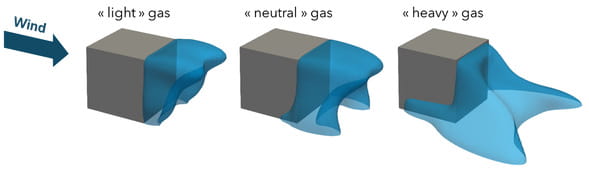
Gas releases whose density differs from that of ambient air behave very differently from conventional emissions due to their physical properties:
- Heavy gas releases: These involve gases that are colder than the surrounding air (e.g., low-temperature saturated steam) or composed mainly of molecules heavier than air (e.g., CO2, propane, chlorinated solvent vapors). Such gases tend to remain close to the ground, accumulate in confined or low-lying areas (trenches, pits, poorly ventilated buildings), and follow the terrain.
- Light gas releases: These consist of gases that are hotter than the surrounding air or made up of molecules lighter than air (e.g., hydrogen, methane, helium). They generally rise rapidly but may disperse unpredictably depending on wind conditions and nearby obstacles.
Specific risks:
- Regulatory non-compliance: Regulations such as the Industrial Emissions Directive (IED) and French ICPE requirements require accurate assessment of environmental impacts, including those associated with non-conventional releases.
- Localized environmental impacts: Heavy pollutants may settle on soil or vegetation, while lighter gases may spread unexpectedly toward sensitive areas.
- Asphyxiation or toxic exposure: Heavy gases can accumulate in enclosed spaces, such as basements or underground parking garages (for example, CO2).
- Explosion hazards: Flammable light gases such as hydrogen or methane may accumulate beneath roofs or ceilings, creating explosive atmospheres.
Three-dimensional modeling is therefore essential to predict these behaviors and implement appropriate safety measures.
Which tools can be used to model dense gas releases?
Several modeling approaches are available, but their suitability depends on the complexity of the surrounding environment.
- Conventional atmospheric dispersion models (Gaussian models):
Software such as ADMS and AERMOD is widely used for atmospheric dispersion studies. These tools can account for gas density and estimate dispersion trajectories. However, they have limitations when representing complex interactions between dense gas releases and their environment, including : wake effects behind buildings, accumulation in confined areas such as depressions or trenches, terrain-induced flow modifications. Although these statistical models are robust for relatively simple situations, they become less accurate when airflow patterns are highly complex. - CFD modeling software (Computational Fluid Dynamics):
For detailed analyses of airflow and interactions with buildings, terrain, and other obstacles, CFD tools such as Code_Saturne provide a much higher level of accuracy. These tools solve the three-dimensional equations governing fluid mechanics, making it possible to:- accurately simulate the behavior of dense gases according to their density, temperature, and meteorological conditions.
- account for recirculation zones behind obstacles, stagnant areas affecting heavy gases, and thermal buoyancy influencing lighter gases.
- model interactions between gas plumes and complex environments, including accumulation within courtyards, dispersion beneath canopies, and valley or urban canyon effects. This capability represents one of the major advantages of CFD compared with conventional Gaussian dispersion models.
Need comprehensive support?
NUMTECH provides studies and engineering services using the modeling tools best suited to your specific needs, including:
- Indoor air pollution assessments.
- 3D simulations of industrial gas releases.
- Industrial risk assessments.
